- Email: unityhospital24x7@gmail.com
- Badarpur, New Delhi-110044
- Call: +91-9958749840
- Call: 011-69139900
Mon - Sun (24*7)

Varicose Veins, Prostate and Thyroid Surgery
Varicose Veins, Prostate and Thyroid Surgery
- Unity Hospital
Our Surgery Department provides evaluation and surgical treatment for a range of conditions beyond routine general surgery, including varicose veins, prostate enlargement, and thyroid disorders that may require operative management. These conditions can s
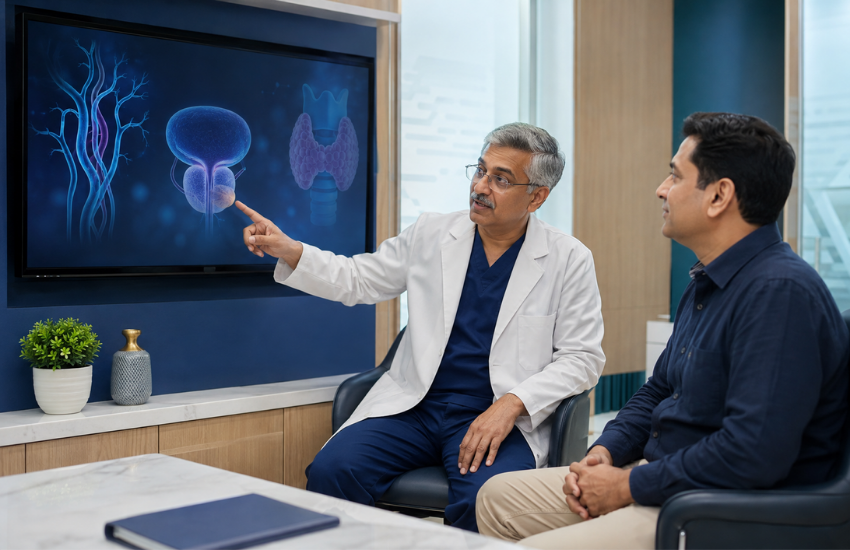
Our Surgery Department provides evaluation and surgical treatment for a range of conditions beyond routine general surgery, including varicose veins, prostate enlargement, and thyroid disorders that may require operative management. These conditions can significantly affect comfort, mobility, daily activities, urinary function, swallowing, breathing, or overall quality of life when symptoms become persistent or progressive.
Our surgeons take an individualised approach to every patient. Treatment is recommended only after a careful assessment of the condition, its severity, associated symptoms, previous treatments, and the patient's overall health. Where non-surgical management is appropriate, it may be considered before surgery. When an operation offers the most appropriate solution, our team carefully plans the procedure with patient safety and long-term outcomes as key priorities.
Varicose Vein Surgery
Varicose veins are enlarged, twisted, and sometimes prominent veins that most commonly develop in the legs. They occur when the valves within the veins do not function effectively, allowing blood to pool and increasing pressure within the affected veins.
Some patients experience varicose veins primarily as a cosmetic concern, while others may develop symptoms such as aching, heaviness, swelling, itching, burning, or discomfort that becomes worse after prolonged standing or walking. More advanced venous disease can sometimes lead to skin discolouration, skin thickening, ulcers, or other complications.
Our surgeons assess the appearance and symptoms of the veins and, when appropriate, recommend investigations to understand the underlying venous circulation. This assessment helps determine whether conservative management, a minimally invasive procedure, or surgery is the most suitable option.
When intervention is required, treatment is directed at the abnormal veins while preserving healthy circulation through the deeper venous system. Depending on the individual case, modern minimally invasive techniques or conventional surgical approaches may be considered.
The aim of treatment is to reduce troublesome symptoms, address problematic veins, improve mobility and comfort, and, where possible, improve the appearance of the affected legs. Patients receive guidance regarding walking, compression when appropriate, wound care, and other measures that support recovery.
Prostate Surgery
An enlarged prostate, commonly associated with benign prostatic enlargement, can cause troublesome lower urinary tract symptoms in men. As the prostate enlarges, it may place pressure on the urethra and interfere with the normal flow of urine.
Symptoms can include difficulty starting urination, a weak or interrupted urine stream, increased frequency of urination, urgency, waking frequently at night to urinate, or a sensation that the bladder has not emptied completely. In some cases, prostate enlargement can contribute to urinary retention or recurrent urinary problems.
Treatment depends on the severity of symptoms and their effect on the patient's quality of life. Medication and other non-surgical measures may be appropriate for many men. However, when symptoms remain significant despite medical treatment, complications develop, or urinary obstruction becomes troublesome, surgical treatment may be considered.
Before recommending prostate surgery, our team conducts a detailed evaluation that may include a review of urinary symptoms, medical history, physical examination, urine testing, blood investigations, and appropriate prostate or urinary tract assessment. The findings help determine whether surgery is indicated and which approach is most appropriate.
When surgery is recommended, the objective is to improve urine flow and reduce symptoms caused by obstruction. Depending on the patient's condition and clinical requirements, an appropriate minimally invasive or endoscopic surgical technique may be considered.
Patients are provided with clear information about the procedure, expected recovery, possible risks, and post-operative care. Follow-up is an important part of treatment to assess urinary function and monitor recovery.
Thyroid Surgery
The thyroid is a gland located in the front of the neck that produces hormones involved in regulating metabolism and several important body functions. Thyroid conditions are common and may present as a thyroid nodule, enlarged thyroid gland or goitre, or other thyroid abnormalities.
Not every thyroid condition requires surgery. Surgical treatment may be recommended when a thyroid swelling or nodule is large, causes pressure symptoms, affects swallowing or breathing, produces concerning findings on investigation, or when there is a confirmed or suspected thyroid cancer. Surgery may also be considered for certain thyroid disorders when other treatment options are not suitable or when the clinical circumstances favour surgical management.
Careful Thyroid Evaluation
Before thyroid surgery, our team conducts a comprehensive assessment to understand the nature and extent of the thyroid condition. Evaluation may include clinical examination, thyroid function tests, ultrasound imaging, and, when appropriate, needle-based sampling of a thyroid nodule.
The results help determine whether surgery is necessary and, if so, how much of the thyroid should be removed. Depending on the condition, surgery may involve removal of part of the thyroid or removal of the entire gland.
Because the thyroid is located close to important nerves and structures in the neck, careful surgical planning and precise technique are essential. Our surgeons take appropriate precautions to minimise surgical risks and protect surrounding structures.
Personalised Surgical Planning
Although varicose vein, prostate, and thyroid conditions involve different parts of the body and require different surgical techniques, our approach to each is based on the same principles of accurate diagnosis, careful planning, and patient-centred care.
Before surgery, patients are assessed for relevant medical conditions, medications, previous procedures, allergies, and other factors that may influence anaesthesia or surgical treatment. The proposed procedure is discussed in detail so that patients understand why surgery is being recommended