
- Email: unityhospital24x7@gmail.com
- Badarpur, New Delhi-110044
- Call: +91-9958749840
- Call: 011-69139900
Mon - Sun (24*7)

Treatment for Birthmarks
Treatment for Birthmarks
- Unity Hospital
Birthmarks are common skin markings that may be present at birth or become noticeable during the first few weeks or months of life. They can vary significantly in colour, size, shape, texture and location. Some birthmarks remain unchanged throughout life,
Birthmarks are common skin markings that may be present at birth or become noticeable during the first few weeks or months of life. They can vary significantly in colour, size, shape, texture and location. Some birthmarks remain unchanged throughout life, while others may gradually become lighter, darker, larger or otherwise change in appearance over time.
Although most birthmarks are harmless and do not require treatment, some may cause cosmetic concerns, discomfort or functional problems depending on their size and location. In certain cases, a birthmark may also need medical assessment and periodic monitoring to ensure that any significant changes are identified early.
Our dermatologists carefully evaluate each birthmark to determine its type, characteristics and likely behaviour. The assessment helps distinguish between different categories of birthmarks and identify whether observation, medical treatment or a cosmetic procedure may be appropriate.
Understanding Different Types of Birthmarks
Birthmarks can broadly be associated with changes in pigmentation or abnormalities involving blood vessels. Their appearance can therefore differ considerably from one patient to another.
Pigmented birthmarks may appear as brown, black or other darker areas of skin. These can include certain types of moles and other pigmentary marks. Vascular birthmarks, on the other hand, may appear pink, red, purple or bluish and are related to blood vessels in or beneath the skin.
Some birthmarks are flat and blend smoothly with the surrounding skin, while others may be raised, textured or associated with changes in the surface of the skin. Their size can range from a small spot to a larger area involving a significant portion of the body.
Because different birthmarks have different characteristics and treatment considerations, identifying the type of birthmark is an important first step before deciding whether treatment is necessary.
Dermatological Assessment of Birthmarks
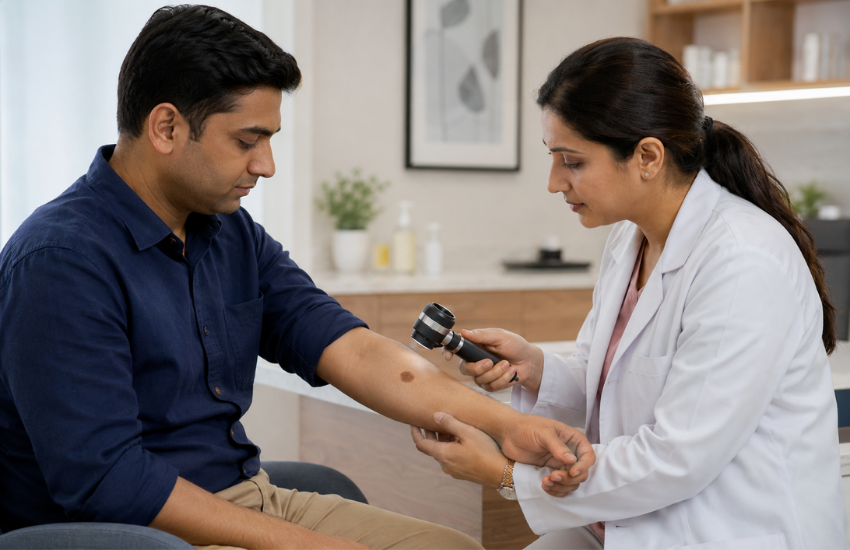
During a consultation, our dermatologists examine the birthmark carefully and consider factors such as its colour, size, shape, borders, texture and location. The doctor may also ask when the mark was first noticed and whether it has changed over time.
Depending on the appearance and clinical assessment, additional examination or monitoring may sometimes be recommended. This is particularly relevant when a birthmark shows noticeable changes or has features that require closer evaluation.
The purpose of assessment is not only to address cosmetic concerns but also to ensure that patients understand the nature of the birthmark and whether any follow-up is advisable.
When Does a Birthmark Require Treatment?
Many birthmarks are completely harmless and do not require treatment. If a birthmark is stable, asymptomatic and does not cause concern, the dermatologist may recommend observation rather than intervention.
Treatment may be considered when:
- The birthmark is causing significant cosmetic concern.
- Its size, colour or appearance has changed.
- It is located in an area where it causes irritation or repeated trauma.
- It affects an important functional area.
- It is associated with symptoms such as discomfort, bleeding or persistent irritation.
- The dermatologist believes further assessment or treatment is medically appropriate.
The decision is individualised and depends on the type of birthmark, its characteristics and the patient's age, overall health and expectations.
Cosmetic Treatment for Birthmarks
For patients who are concerned about the appearance of a birthmark, a range of treatment options may be considered depending on its type.
Certain vascular birthmarks may respond to laser or light-based treatments designed to target blood vessels. Some pigmented birthmarks may be evaluated for procedures intended to reduce pigmentation or improve their appearance. In selected cases, surgical removal may also be considered, particularly when the birthmark is suitable for excision.
However, not every birthmark can be completely removed, and some treatments may improve its appearance rather than eliminate it entirely. The dermatologist will discuss the likely degree of improvement, the number of sessions that may be required and the potential risks before treatment begins.
Laser and Light-Based Treatments
Laser treatment can be useful for selected types of birthmarks, particularly certain vascular or pigmented lesions. Different laser technologies target different components of the skin, so the choice of treatment depends on the characteristics of the birthmark.
The number of sessions required can vary considerably. Some birthmarks may require multiple treatments spaced over several weeks or months, while others may respond differently.
Laser procedures can also have potential side effects, including temporary redness, swelling, changes in pigmentation or, less commonly, scarring. These risks are discussed during consultation, and treatment is selected according to the patient's skin type and the nature of the birthmark.
Surgical Removal
For certain birthmarks, surgical removal may be an appropriate option. This involves removing the affected area and closing the skin carefully to allow healing.
Surgery may be considered when the birthmark is raised, particularly large, symptomatic or otherwise suitable for excision. The location and size of the birthmark are important considerations because they can influence the final appearance of the scar.
Patients are informed about the expected healing process and the possibility of scarring before proceeding. In some cases, complete removal may not be recommended if doing so would result in a less favourable cosmetic outcome or unnecessary risk.
Birthmarks in Children
Birthmarks are frequently noticed in infants and children, and many do not require immediate treatment. Some may naturally become less noticeable as the child grows, while others may become more prominent or change during childhood.
For children, treatment decisions are made carefully, taking into account the type and location of the birthmark, its behaviour over time and whether it causes functional or psychological concerns.
In many cases, regular observation is appropriate. If treatment becomes necessary, the dermatologist can discuss the safest and most suitable timing and treatment approach.
Monitoring Changes in a Birthmark
Although most birthmarks are harmless, patients should pay attention to significant changes in their appearance. Changes in size, shape, colour, texture or symptoms should be brought to the attention of a dermatologist.
Particular attention may be warranted if a mark begins to bleed, develops persistent irritation, becomes painful, changes rapidly or develops noticeably different characteristics from its previous appearance.
Regular dermatological assessment can provide reassurance and help determine whether continued observation is sufficient or whether further evaluation is appropriate.
Realistic Expectations From Treatment
The outcome of birthmark treatment depends heavily on the type of birthmark, its depth, size, location, skin type and the treatment selected. Some birthmarks can be significantly lightened or reduced, while others may only be partially improved.
Patients should understand that complete removal without any visible residual mark or scar is not always possible. Multiple treatment sessions may sometimes be necessary, and the final result may become apparent gradually as the skin heals.
Our dermatologists provide an honest assessment of what can realistically be achieved and explain the potential benefits, limitations, risks and expected recovery associated with the recommended treatment.
Personalised Birthmark Care
Every birthmark is different, so treatment should not be based solely on its colour or appearance. A procedure that is suitable for one type of birthmark may not be appropriate for another.
Our approach begins with careful clinical assessment and continues with a personalised treatment plan based on the patient's individual needs and expectations. Where treatment is not necessary, patients are advised accordingly rather than undergoing an unnecessary procedure.
For patients seeking cosmetic improvement, we focus on selecting an appropriate option that balances effectiveness, safety and the expected aesthetic outcome.
Conclusion
Birthmarks can range from small, subtle marks to more noticeable areas of pigmentation or vascular change. While most are harmless and can simply be monitored, some may benefit from medical or cosmetic treatment.
A professional dermatological evaluation helps determine the type of birthmark, whether it requires monitoring and which treatment options, if any, may be appropriate. Depending on the diagnosis, management may include observation, laser or light-based procedures, surgical removal or other specialised treatments.
Our goal is to provide personalised, safe and realistic care while ensuring that patients understand both the potential benefits and limitations of treatment. With appropriate assessment and an individualised approach, many birthmarks can be effectively monitored or cosmetically improved according to the patient's needs and expectations.